The Church and Mental Illness
There is a particular kind of loneliness that settles in when faith communities grow quiet around the very struggles their members carry every day. Someone can sit in a pew, hands folded and heart racing, and still feel invisible because the conversation never quite reaches the harder edges of living with a mind that does not behave. Many people raised in church settings learned early that certain stories are welcome and others belong behind closed doors, and that sorting quickly becomes a kind of gospel of its own. Yet the people who actually show up week after week often long for a table where the full weight of a life can be set down. Spiritual space that allows for trembling questions, awkward pauses, and honest exhaustion tends to be the same space where genuine healing begins to take root.
Mental illness has always lived inside the body of faith, even when the vocabulary used to name it has shifted across generations. What older communities might have called worry, melancholy, or a burdened spirit often maps onto experiences now described by clinicians, and that shift in language can either build a bridge or widen a gap. When a congregation leans into curiosity rather than correction, it opens room for stories that include hospital stays, difficult medications, seasons of insomnia, and days when getting out of bed is the day's greatest victory. That posture does not require pastoral training or theological expertise; it only requires a willingness to listen longer than feels comfortable. Listening well, in many cases, is the most overlooked form of prayer a community can offer to someone navigating a mind that rarely sits still.
There is also a quiet grief that comes with worshiping alongside people who do not yet have a framework for what you live with. Songs about peace can sting when your own nervous system has forgotten the shape of calm, and prayers for healing can land differently when healing looks less like a cure and more like an ongoing conversation with your own limits. Recognizing that gap is not a reason to drift away from a spiritual home; it is often an invitation to help shape one that is more honest. Many people living with mood disorders discover that their hardest days produce some of their deepest longings, and those longings can become a kind of theology all their own. A faith that can hold lament without rushing to resolution is often the faith that ends up sustaining someone for the long haul.
Churches that want to care well do not need to become therapists or diagnostic centers; they need to become fluent in the language of presence. That might mean training greeters to recognize when a regular attendee has gone quiet for a few weeks, or simply remembering that the mom in the third row is also managing a diagnosis that requires rest. Small, repeated acts of attentiveness tend to matter more than the occasional sermon series, because mental illness unfolds in the ordinary rhythm of days rather than in dramatic moments. A casserole delivered during a hard week, a text that does not require a reply, a willingness to sit with someone who is not yet ready to talk, all of these accumulate into a kind of communal medicine. Presence, practiced patiently, is a form of love that many people never knew they were missing.
At its core, this conversation is about who gets to belong at the table and on what terms. A community that claims to follow a God who moved toward lepers, outcasts, and the grieving cannot easily justify a careful distance from those whose suffering happens to be neurological rather than physical. Naming that inconsistency is not an attack on the church; it is often a faithful act of hoping for something better. The stories written here, and the kind of spirituality that gathers around them, are part of a longer tradition of people who refused to pretend their lives were cleaner than they actually were. Faith that can survive the messiness of a real human life is rarely tidy, and it does not need to be. It only needs to be true, and to make room for the hearts that show up exactly as they are.
“Your chemistry in your brain is not your character.
Your mental illness is not your identity.” Pastor Rick Warren
The Gathering on Mental Health and the Church
2014
Plenary 1: The Role of the Church in Mental Health – Rick Warren, Bishop Kevin Vann
LifeWay Research:
Half of Evangelicals Believe Prayer Can Heal Mental Illness
LifeWay Research:
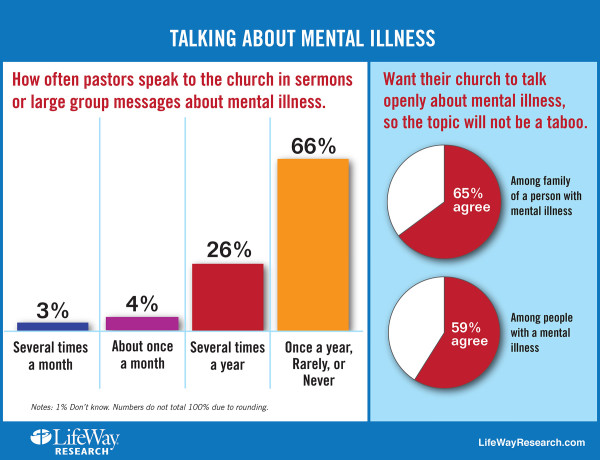
Mental Illness Remains Taboo Topic for Many Pastors